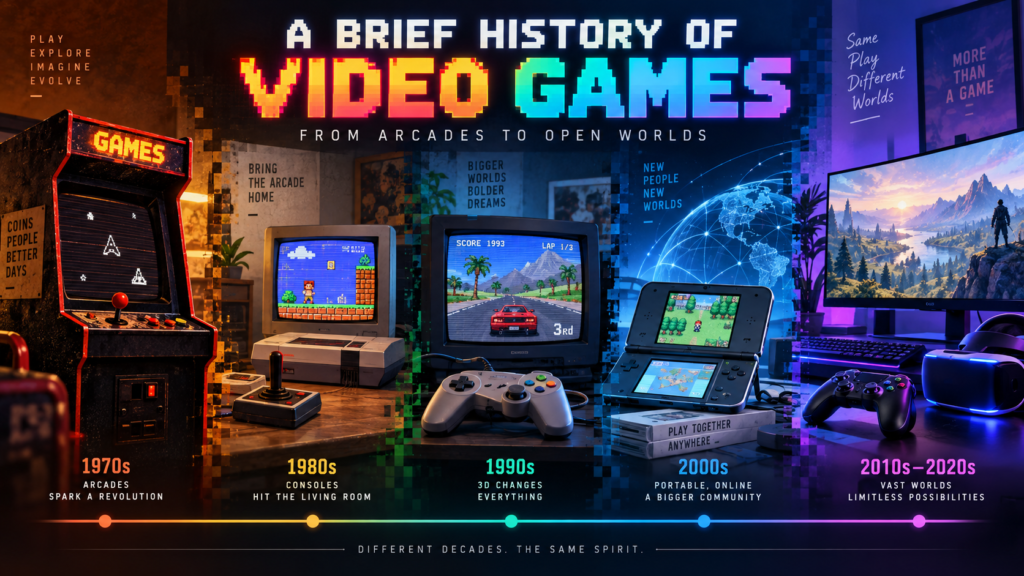
Video games have come a long way from the simple glowing shapes and electronic beeps of the 1970s. What began as a technological curiosity has grown into one of the largest entertainment industries in the world, influencing art, music, storytelling, technology, and popular culture along the way.
The Arcade Era
The modern video game industry began taking shape during the 1970s, when arcade machines started appearing in bars, restaurants, shopping centers, and dedicated arcades.
Early games were remarkably simple by modern standards. Players controlled basic shapes, spaceships, paddles, or vehicles while competing for high scores. Yet these games introduced many ideas that remain important today: quick challenges, increasing difficulty, competitive play, and the desire to try just one more time.
Arcades also made gaming a social experience. Players gathered around cabinets, watched skilled players chase high scores, and competed for a place on the leaderboard.
By the end of the decade, video games were no longer just experiments. They were becoming a genuine form of entertainment.
Gaming Comes Home
During the 1980s, the living room became the next major battlefield.
Home consoles allowed players to experience arcade-style games without leaving the house. Instead of inserting another coin after every defeat, players could spend hours learning levels, discovering secrets, and improving their skills.
This era also helped establish many of the conventions associated with traditional video games. Platformers, action games, role-playing games, racing games, puzzle games, and adventure titles all became increasingly sophisticated.
Developers were working with extremely limited hardware, which forced them to be creative. Characters had to be recognizable using only a handful of pixels. Music had to be written using basic synthesized sound channels. Entire worlds had to fit inside cartridges containing a tiny fraction of the storage available on modern devices.
Those limitations helped create a distinctive visual and musical style that remains popular decades later.
The Leap to 3D
The 1990s changed everything.
More powerful consoles and personal computers made three-dimensional graphics practical for mainstream games. Developers could suddenly create environments that players explored from entirely new perspectives.
Racing games became more immersive. Fighting games experimented with 3D arenas. Adventure games offered larger environments, while first-person games placed players directly inside digital worlds.
Compact discs also provided much more storage than traditional cartridges. Games began incorporating recorded dialogue, cinematic music, animated cutscenes, and larger amounts of artwork.
The decade represented one of the biggest technological jumps in gaming history. By its end, developers were already creating experiences that would have seemed almost impossible only ten years earlier.
The Online Revolution
During the 2000s, gaming became increasingly connected.
Online multiplayer allowed players from different cities and countries to compete or cooperate in the same virtual environments. PC games had already demonstrated the potential of online communities, but broadband internet and improved console networking brought the experience to a much wider audience.
Games were no longer necessarily finished when they shipped. Developers could release patches, additional maps, downloadable content, and major expansions.
Portable gaming also continued to grow. Handheld systems allowed players to take surprisingly large adventures with them, while improving mobile hardware eventually introduced millions of new people to games through phones and tablets.
Gaming was becoming something people could do almost anywhere.
Bigger Worlds and Greater Freedom
During the 2010s, hardware became powerful enough to create enormous environments filled with characters, quests, vehicles, wildlife, weather systems, and interactive objects.
Open-world design became especially popular because it gave players greater freedom. Instead of following a single predetermined path, players could explore, experiment, and sometimes completely ignore the main objective.
Independent game development also experienced enormous growth. Digital distribution made it possible for small teams—or even individual developers—to release games to global audiences without manufacturing physical copies.
Some of the most creative games of the era came from developers working with comparatively small budgets.
At the same time, streaming platforms transformed gaming into spectator entertainment. Watching someone else play became nearly as normal as playing yourself.
Gaming Today
Modern gaming includes almost every idea introduced during the industry’s history.
Retro-inspired pixel games exist alongside enormous photorealistic worlds. Competitive esports sit beside quiet narrative adventures. Virtual reality continues to experiment with immersion, while cloud technology is changing where games need to run.
Players can experience games on consoles, computers, handheld systems, tablets, phones, and headsets.
Yet despite decades of technological progress, the fundamental appeal hasn’t changed very much.
A great video game still presents a player with a world, a challenge, or an idea and asks a simple question:
What happens if you try?
From crowded arcades to massive online worlds, video games have continually reinvented themselves while preserving that sense of interaction and discovery.
And if the history of gaming tells us anything, the next transformation probably isn’t as far away as we think.